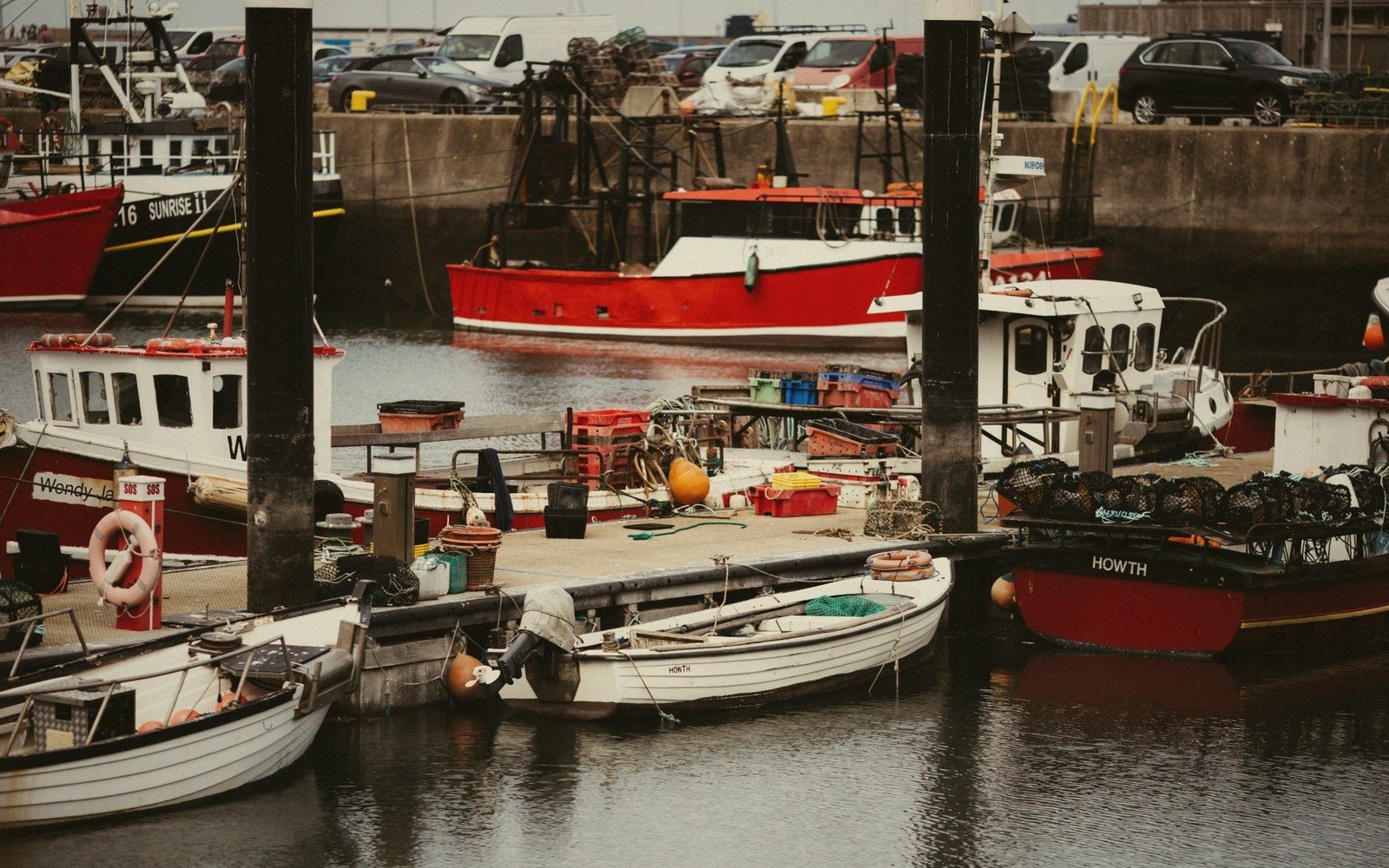
One of England's busiest fishing ports — where the morning catch travels metres from net to plate, and the smell of the sea is everywhere.
A Working Port at the Bay's Southern Tip
Brixham sits at the southern end of Torbay, a town that has never entirely given itself over to tourism because it was already busy doing something else. The harbour here is not decorative; it is a working fishing port — one of the largest by value in England — and the boats that crowd the inner basin are not pleasure craft but trawlers, rigged and purposeful, heading out past Berry Head into the Channel.
The fish market on the quay operates through the small hours, a wholesale auction where buyers from across the South West bid on the night's haul. Visitors don't usually attend, but its existence explains everything about how Brixham eats. The crab and lobster in the harbourside restaurants came off a boat this morning. The battered cod in the chip papers being eaten on the harbour wall might have been swimming off Start Point yesterday. That gap between sea and plate is vanishingly small, and you can taste it.
The harbour itself is picturesque in the way of genuinely functional things — colourful hulls, rigging, the tang of salt and diesel, a statue of William of Orange who landed here in 1688 before marching north to claim the English throne. A full-size replica of the Golden Hind, the vessel in which Francis Drake completed his circumnavigation of the world in the sixteenth century, is moored in the outer harbour as a museum ship and draws curious visitors year-round. But these attractions feel almost incidental to the main event, which is the port doing what it has always done.
One of England's busiest fishing ports — where the morning catch travels metres from net to plate, and the smell of the sea is everywhere.
What to Eat, and Where
The guiding principle in Brixham is simple: eat what arrived that morning. Crab is the headline — dressed brown and white crab served cold, piled into sandwiches, or alongside good bread and a pint of something local. Lobster appears on menus that change with the catch rather than the season, and if the boats have been out in the right waters, scallops show up too. Dover sole, lemon sole, bass, brill — the list shifts with the tides.
The restaurants and cafés that line the quay and climb the streets above the harbour vary considerably in style and price, from informal counter-service places to proper sit-down restaurants with tablecloths. What unites the best of them is straightforwardness: a place confident in the quality of its ingredients rarely overcomplicates things. Look for menus that name the boat or the landing, and be cautious of anything that lists a dozen species — the smaller the range, the more likely it's today's.
Fish and chips eaten on the harbour wall is not a lesser option. Brixham's chippies take their supply lines as seriously as the restaurants; the same boats feed both. Find a spot where you can watch the trawlers and you have, genuinely, one of the better meals the English Riviera offers.
For crab, the inner harbour is the place to linger — some fishermen sell dressed crab direct from the quay or from small stalls nearby, the kind of transaction that makes you feel the town is still operating on its own terms.
Getting There and Getting Around
Brixham lies at the end of the road in every sense — it is not on the way to anywhere else, which is part of what has kept it itself. From Torquay, it is a twenty-minute drive around the bay, or a longer and more scenic journey on the local bus that runs down through Paignton. In summer a passenger ferry runs across the bay from Torquay harbour, arriving directly at Brixham's quay — this is the better approach if the weather is fine, giving you the port from the water before you set foot on dry land.
Berry Head, the limestone headland that closes off the southern bay, is worth the short walk from the harbour. The views back across Torbay are among the widest in Devon, and the headland is a nature reserve with nesting seabirds on its cliffs. It puts the whole bay in context — Torquay curving north, the red cliffs of Paignton in the middle distance, and below you, the boats making their way out again.
— How it unfolded
- 16th centuryFrancis Drake's circumnavigation, commemorated by the Golden Hind replica
- 1688William of Orange lands at Brixham, beginning the Glorious Revolution
— People & places
William of Orange
Dutch prince who landed at Brixham in 1688; commemorated by harbour statue
Francis Drake
Elizabethan navigator; Golden Hind replica moored in outer harbour
Berry Head
limestone headland south of Brixham; nature reserve with cliff seabirds
Brixham fish market
wholesale overnight auction, one of England's largest by value