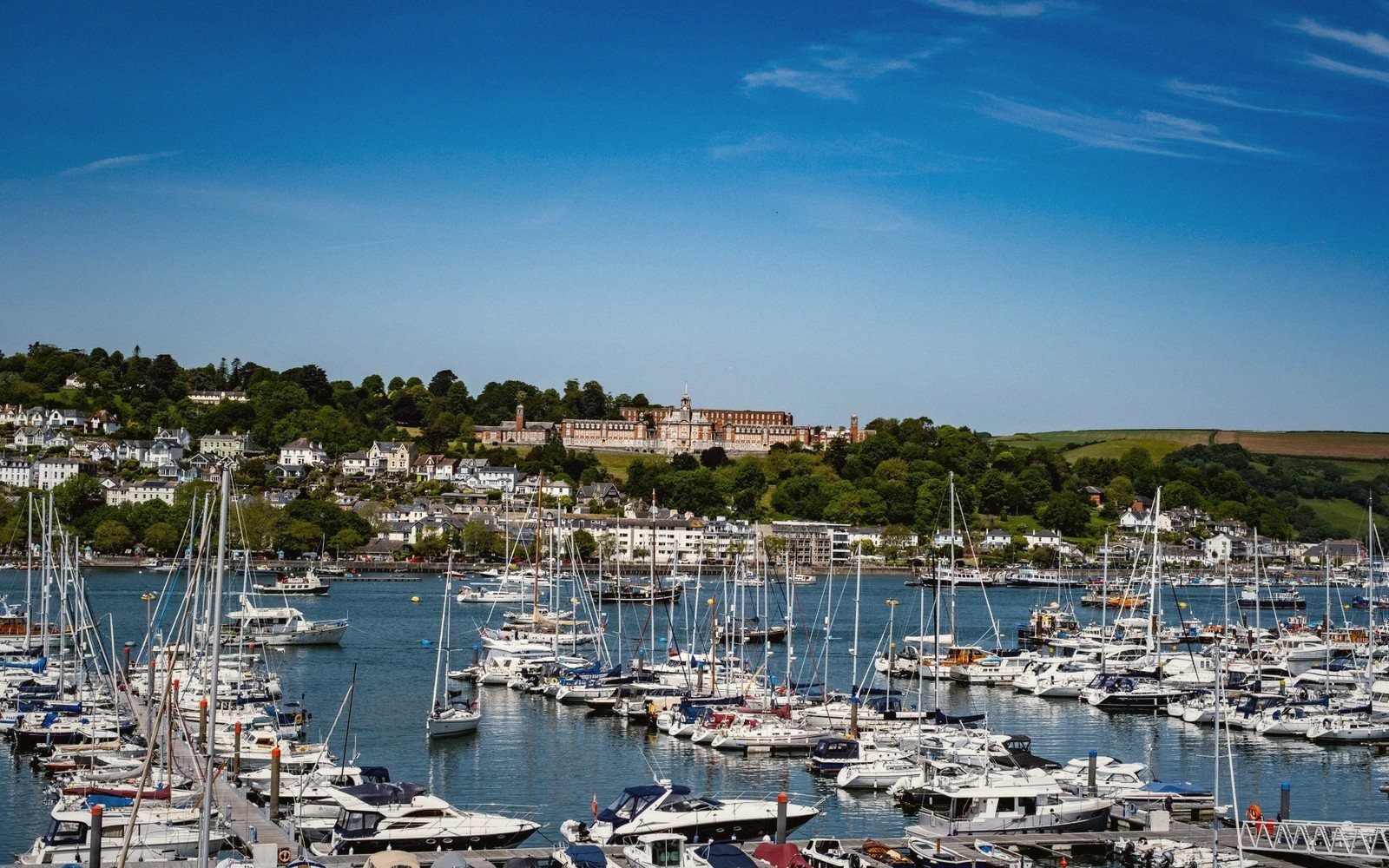
One of Devon's great day-trip combinations: a vintage steam railway hugging the coast, then a short ferry crossing to one of England's most beautiful estuary towns.
Steam, Coast and River
The Dartmouth Steam Railway runs between Paignton and Kingswear, tracing a route that clings to the edge of Torbay before turning inland along the Dart estuary. It is one of those journeys that feels almost too cinematic to be real — red sandstone cliffs dropping to the sea on one side, rolling Devon farmland on the other, with a vintage locomotive doing the work and doing it loudly. The line was originally part of the Great Western Railway network, reaching Kingswear in the 1860s, and the stretch between Goodrington and Churston remains one of the most scenic short railway journeys in England.
Trains depart from Paignton station, where the heritage railway sits alongside the mainline connection from Exeter — a practical detail that makes this an easy day out even without a car. The journey south takes around half an hour in total, calling at Goodrington Sands Halt (where passengers spill out for the beach in summer), Churston and finally Kingswear on the eastern bank of the Dart. Each station is kept in period dress, staffed by volunteers whose collective enthusiasm for the whole enterprise is genuinely infectious.
The steam engines themselves rotate through the service, so there is no guarantee of which locomotive you will ride behind — part of the appeal, in a way. Rolling stock includes restored Great Western coaches, and on a clear day with the window down and the smell of coal smoke drifting back through the carriages, it is easy to understand why so many people make this journey year after year.
The line was originally part of the Great Western Railway network, reaching Kingswear in the 1860s, and the stretch between Goodrington and Churston remains one of the most scenic short railway journeys in England.
Across the Dart to Dartmouth
Kingswear is charming — a tight cluster of colour-washed houses above a working quayside — but it is a staging post, not the destination. Dartmouth sits directly opposite, close enough to shout across on a calm day, and a passenger ferry makes the crossing in minutes. The higher ferry for vehicles runs separately; foot passengers use a small float that shuttles back and forth throughout the day, dropping you more or less in the centre of Dartmouth's quayside.
Dartmouth itself repays the effort handsomely. The town has been a significant harbour since the Middle Ages — it fitted out ships for the Second and Third Crusades, and its deep-water anchorage gave it strategic importance for centuries. The castle at the mouth of the estuary dates from the fifteenth century and sits on one of the more dramatic defensive positions in the South West. The Dartmouth Museum, housed in a seventeenth-century merchant's house on the Butterwalk, gives a compact account of all of it without overstaying its welcome.
The town is also excellent for food. The quayside and the streets immediately behind it are dense with restaurants and cafés working largely with local and South Devon seafood — crab, mussels, fish from nearby Brixham, which lands one of the largest catches on the English south coast. A lunch at one of the harbour restaurants, with the Dart traffic moving behind you, is one of Devon's more straightforward pleasures.
Allow two or three hours in Dartmouth proper. The Embankment and the tangle of medieval streets behind it are easily walkable; if time and energy allow, the coastal path south towards the castle stretches the legs and opens up views back across the estuary that make the whole setting properly clear.
Planning the Day
The steam railway typically runs a seasonal timetable, busiest through the summer months and with a reduced service at other times of year — check before you travel. Return tickets allow you to ride both ways, or you can simply catch the train one way and return via Paignton by road or local bus if you prefer to spend longer on the Dartmouth side.
Start reasonably early: Dartmouth gets busy in high summer, parking in Kingswear is limited, and the first trains tend to carry lighter crowds. Arriving at Paignton by mainline train from Torquay takes only a few minutes and sidesteps the parking question entirely. Bring layers — the open carriages can be breezy whatever the season — and leave room for lunch on the other side of the river.
— How it unfolded
- 1860sGreat Western Railway line extended to Kingswear
- Medieval eraDartmouth fitted out ships for the Crusades
- 15th centuryDartmouth Castle built at the estuary mouth
— People & places
Dartmouth Steam Railway
heritage steam line running Paignton to Kingswear
Kingswear
village on the east bank of the Dart, railway terminus
Dartmouth
historic estuary town, reached by ferry from Kingswear
Dartmouth Museum
compact local history museum in the 17th-century Butterwalk
Goodrington Sands Halt
intermediate station with beach access
Churston
intermediate station between Goodrington and Kingswear
Brixham
major nearby fishing port supplying local seafood