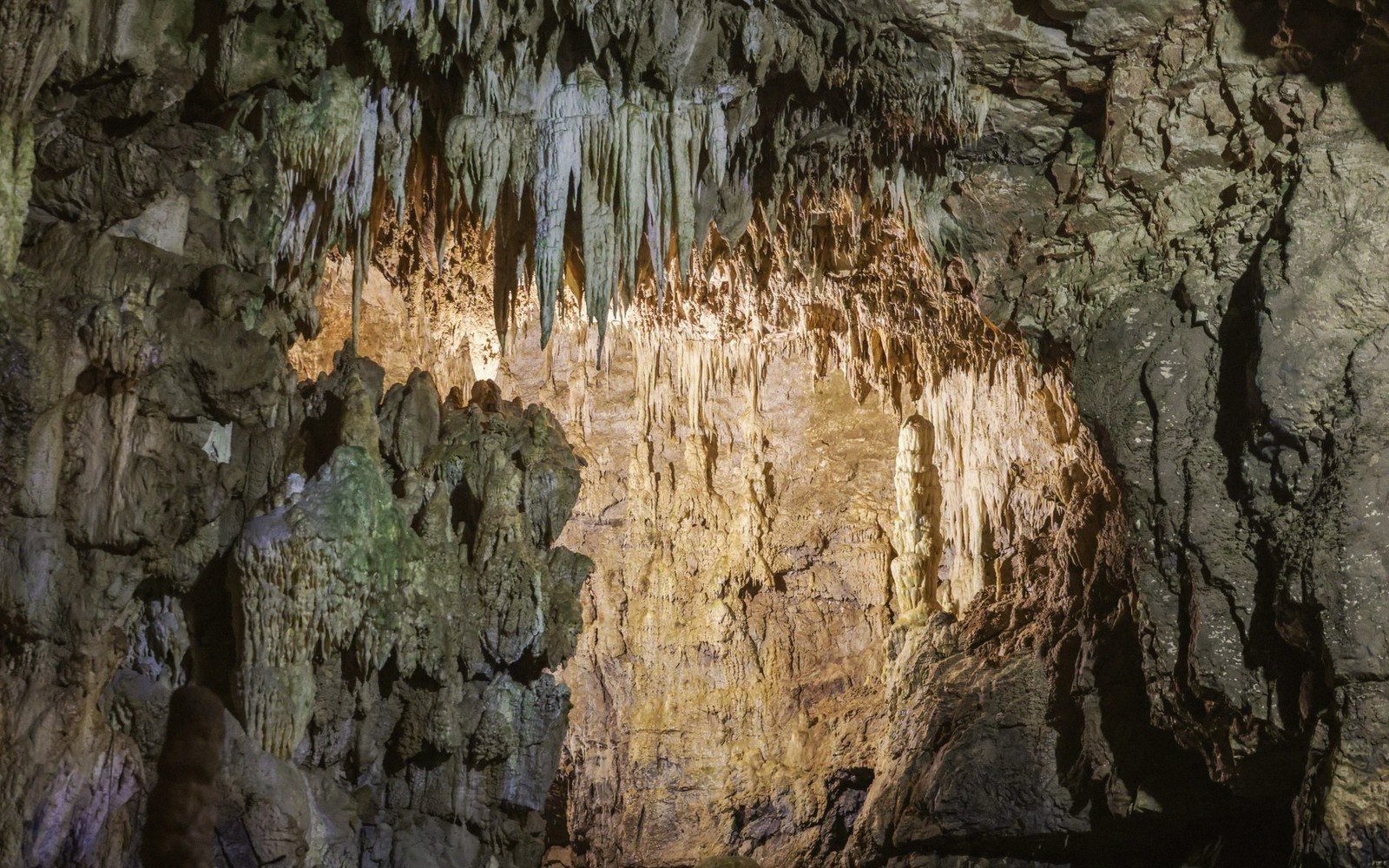
A limestone labyrinth beneath Torquay holds some of the oldest evidence of human life in Britain — an extraordinary walk through deep time, and a great day out in any weather.
Half a Million Years Under Torquay
The hill above Wellswood doesn't look like much from the road. But beneath it runs one of the most remarkable sites in British prehistory: Kents Cavern, a network of limestone caves whose tunnels and chambers have been carved by water, reshaped by ice ages and occupied — on and off — for roughly half a million years. Human teeth, animal bones and worked flint tools found here push the evidence of human presence in Britain back further than almost anywhere else in the country.
The find that rewrote the record books was a fragment of human jawbone, unearthed in 1927 and later dated to somewhere between 41,000 and 44,000 years old — among the earliest known anatomically modern human remains found in northwest Europe. Long before that, earlier hominins were sheltering here too, leaving behind stone tools that suggest occupation stretching back hundreds of thousands of years. The caves were home to cave bears, woolly mammoths, woolly rhinoceroses and sabre-toothed cats. Walking the chambers now, it is easy to feel the weight of that span: a single stalactite growing at a millimetre a century makes the centuries visible.
Human teeth, animal bones and worked flint tools found here push the evidence of human presence in Britain back further than almost anywhere else in the country.
What to Expect on a Visit
Kents Cavern operates as a guided tour attraction, which is exactly what these caves need. The guides are knowledgeable without being dry, and the pace is gentle enough for families with young children. The route through the cave system is well-lit and the main passages are easily walkable, though some lower sections require a slight stoop — sensible footwear helps and a layer is wise even in summer, since the caves maintain a constant cool temperature year-round.
The tour moves through a sequence of dramatically different chambers. The Great Chamber opens up with cathedral-like scale after the narrow entrance tunnels. Elsewhere, flowstone formations — sheets of calcium carbonate deposited over millennia — ripple across the walls in curtains of amber and cream. The guides explain the archaeology as you go: where the bones were found, how excavation was done in the nineteenth century when the science was young, and what those finds tell us now. The Victorian excavations, led by the antiquarian William Pengelly in the 1860s and 1870s, were notably methodical for their era and helped establish the field of systematic archaeological excavation in Britain.
After the tour, the site has a café and outdoor space — useful for families needing to decompress — and a small exhibition area giving context to the finds. The original bones and artefacts have long since moved to museum collections, but the interpretation on site is solid and the caves themselves are the real exhibit.
Rainy Day, Any Day
Kents Cavern earns its place near the top of any rainy day in Torquay itinerary, but it would be a shame to save it only for bad weather. The caves are about a mile from Torquay's seafront — easily reached by car, and walkable from the town centre if you don't mind a short uphill stretch through suburban Wellswood. They sit in an area of the bay that already rewards exploration: Anstey's Cove lies close by, and the South West Coast Path runs along the cliffs above.
For children, the combination of darkness, ancient bones and enormous extinct predators tends to land extremely well. For adults with any interest in deep history, geology or the sheer improbability of human survival across ice ages, the caves offer something rarer than most tourist attractions: genuine wonder, grounded in real science, in a place where the evidence is right there in the rock around you.
A visit takes around an hour for the guided tour, plus time before and after. Book ahead, especially in summer, when spaces fill — this is one of the busiest and best-loved sites on the English Riviera.
— How it unfolded
- Hundreds of thousands of years agoearly hominin occupation evidenced by stone tools
- 41,000–44,000 years agoanatomically modern humans sheltering in the caves
- 1860s–1870sWilliam Pengelly's systematic excavations
— People & places
Kents Cavern
limestone cave network in Wellswood, Torquay; one of Britain's most important prehistoric sites
William Pengelly
Victorian antiquarian who led methodical excavations of Kents Cavern in the 1860s–70s
Wellswood
residential area of Torquay where Kents Cavern is located