Torbay raised the world's best-selling novelist. Follow her story from the seafront hotels of her childhood to the riverside garden she loved above all.
A Town That Made a Writer
Agatha Christie was born in Torquay in 1890, in a Victorian villa called Ashfield on what is now Barton Road, and the town imprinted itself on her imagination so thoroughly that traces of it surface in novels written decades later and thousands of miles away. She grew up watching the bay from clifftop gardens, swimming at Anstey's Cove and Meadfoot, attending balls at the seafront hotels — and all of it fed the restless, observant mind that would eventually produce more than sixty detective novels and become, by most reckonings, the best-selling fiction writer in history.
The house itself is gone, demolished in the 1960s and replaced by a housing estate — one of those losses that only becomes clearer with time. But the landscape Christie moved through remains, and following it is one of the more rewarding ways to understand both the writer and the place. Torquay is not shy about its most famous daughter: a bronze statue on the harbourside, a heritage trail threading the town, a literary festival that bears her name. What the town is less good at marketing is the depth of the connection — how thoroughly the English Riviera's particular light, its red-cliffed coves and its peculiar social world seeped into her work.
She grew up watching the bay from clifftop gardens, swimming at Anstey's Cove and Meadfoot, attending balls at the seafront hotels — and all of it fed the restless, observant mind that would eventually produce more than sixty detective novels and become, by most reckonings, the best-selling fiction writer in history.
The Seafront World She Knew
Start at the seafront, because that is where Victorian and Edwardian Torquay played out its social life, and Christie's childhood was woven through it. The Grand Hotel on the seafront is among the most directly Christie-connected buildings still standing: she danced here as a young woman, and it was where she began her honeymoon with Archibald Christie in 1914. The building retains its late-Victorian scale and setting, facing the bay in the way that grand seaside hotels were designed to — as if the sea were a performance put on for their guests.
The Imperial Hotel, set high above Meadfoot on a promontory with sweeping views across the water, features in Christie's work almost directly: it is widely taken as the model for the fictional Majestic Hotel, where Hercule Poirot investigates in Peril at End House and again in Evil Under the Sun. Christie knew the building well, and it is easy, standing here and looking out at the bay, to understand why it lodged in her imagination as a self-contained world — guests circling the same terraces, the same routines, the same closed society that detective fiction requires.
Meadfoot Beach itself, sheltered below the cliffs and reached down a wooded lane, was one of Christie's favourite swimming spots. It is still one of the most quietly beautiful places in Torbay to swim — a long pebble-and-sand cove with clear water and a particular sense of remove from the town above. At Anstey's Cove, a short distance north along the coast, the connection is equally strong: Christie swam here regularly, and the small shingle cove tucked beneath its limestone headland feels barely changed.
Following the Trail Inland
The town holds further threads if you look for them. Torre Abbey, the medieval monastery turned museum near the seafront, has a room dedicated to Christie — fitting, given that the abbey's long history and its position at the edge of the town make it a kind of anchor for Torquay's heritage, Christie's very much included. The abbey's walled gardens and museum are worth a morning regardless of the Christie connection, but the room here gives useful biographical context before you head further afield.
Cockington, the thatched village tucked into a wooded valley barely a mile from the sea, appears in Christie's writing and was part of the landscape she knew from childhood. She walked here, and the village's sense of suspended time — the thatched forge, the old court, the country park around it — makes it easy to feel the connection. It is one of those places that seems designed to harbour secrets, which may explain why it appealed to her.
The Christie heritage trail itself threads the town, marked and mapped, picking out surviving buildings and significant locations. It is a pleasant few hours' walking, and Torquay's topography — those steep red-sandstone hills dropping to the harbour — means the route delivers good views as a matter of course. The bronze statue on the harbourside, unveiled in 1990 on the centenary of her birth, is the natural starting point, a few steps from where the fishing boats still unload and where the palm trees lining the promenade make Torquay feel, on a clear day, quietly Mediterranean.
Greenway: The House on the Dart
If the Torquay seafront was Christie's social world, Greenway was her sanctuary — and it is the single most atmospheric stop on any Christie pilgrimage in Devon. The Georgian house above the River Dart was Christie's summer home from 1938 until her death in 1976, bought on impulse after a boat trip on the river and restored to something close to the way she left it. The National Trust has cared for Greenway since 2000, and the family went to considerable lengths to preserve not just the house but its mood: books left open, objects as Christie arranged them, the sense that someone has just stepped out into the garden.
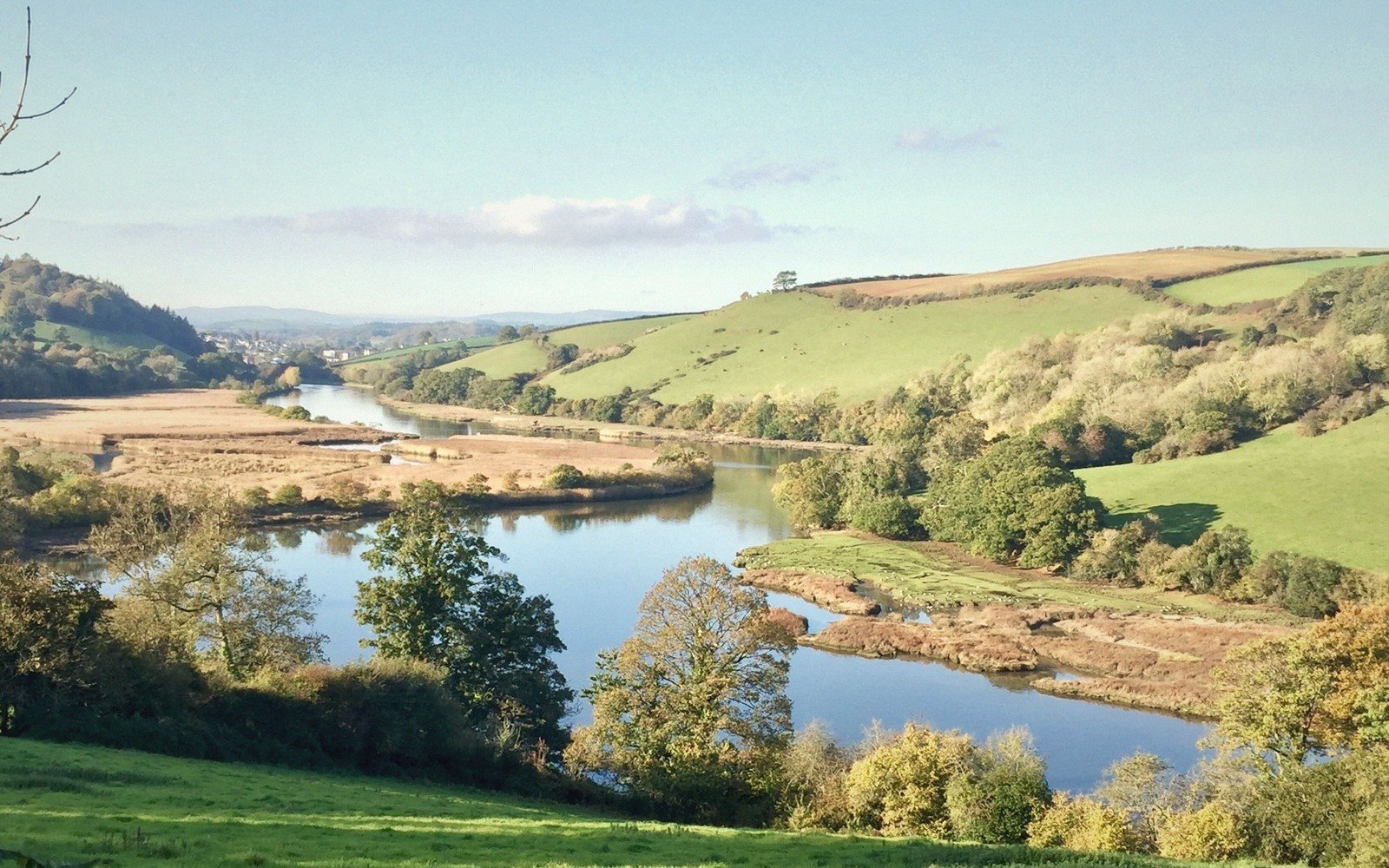
The setting is extraordinary. The house sits in wooded grounds above a sweeping bend in the Dart, with views down through oak and beech to the water. The garden was one of Christie's great passions — she worked on it for decades, and the walled garden, the peach house, the kitchen garden and the woodland paths reflect that sustained attention. In spring and early summer, particularly, it is one of the finest gardens in Devon, its formality softened by the surrounding woodland and the Devon light.
The boathouse down by the river is where Christie set one of her most celebrated scenes: in Dead Man's Folly, the body is discovered in a boathouse — one very like the real building that still stands at the water's edge. Whether or not you arrive knowing the novel, the boathouse carries a particular atmosphere; it is the kind of place that feels charged with fictional possibility, which is perhaps what made it irresistible to Christie.
Greenway is most atmospherically reached by boat — the passenger ferry up the Dart from Dartmouth or Paignton is one of the great Devon journeys, the river narrowing and thickening with trees as you approach the private quay. The steam train to Dartmouth runs along the coast and connects with a river ferry, threading one of Devon's great scenic routes and depositing you at the bottom of Greenway's own garden path.
The World She Built From This Shore
Christie left Torquay as a young woman, first for the duration of the First World War, then more permanently — London, travels abroad, the house in Oxfordshire that became her main home in later life. But she returned to Devon every summer until late in her life, and the landscapes of Torbay and the Dart never really left her work. The red cliffs, the sheltered coves, the grand hotels on their promontories, the winding lanes and the boat trips on the river — all of it circulates through the Poirot and Miss Marple novels in displaced, reimagined forms.
What makes the Christie coast worth following isn't simply literary pilgrimage, though it is that. It is the way tracing her geography makes you look at a familiar — or newly familiar — landscape more closely: the cove she swam in, the hotel ballroom where she danced, the river she loved and the garden she shaped over nearly four decades. Torbay is a beautiful stretch of coast on its own terms. Christie's presence in it makes it a little more layered, and a good deal harder to take for granted.
| On the Christie coast | What’s there | Best reached by |
|---|---|---|
| The Grand Hotel | Where Christie honeymooned with Archibald in 1914 | Seafront, on foot |
| The Imperial Hotel | Model for the fictional Majestic in Peril at End House | Clifftop above Meadfoot |
| Torre Abbey | Medieval museum with a dedicated Christie room | Ten minutes from the seafront |
| Greenway | Her Georgian summer home, kept as she left it | River ferry up the Dart |
— How it unfolded
- 1890Agatha Christie born in Torquay, at Ashfield on Barton Road
- 1914Married Archibald Christie; honeymoon at the Grand Hotel, Torquay
- 1938Bought Greenway above the River Dart
- 1960sAshfield demolished, replaced by housing
- 1976Christie's death
- 1990Bronze statue unveiled on Torquay harbourside
- 2000Greenway transferred to National Trust care
The English Riviera
— People & places
Agatha Christie
Torquay-born crime writer; world's best-selling fiction author
Ashfield
Christie's birthplace on Barton Road, Torquay; demolished 1960s
The Grand Hotel
Seafront Torquay hotel; Christie honeymooned here in 1914
The Imperial Hotel
Clifftop hotel above Meadfoot; model for Christie's fictional Majestic Hotel
Torre Abbey
Medieval monastery turned museum; holds a Christie room
Greenway
Christie's Georgian summer home above the River Dart; National Trust
Hercule Poirot
Christie's Belgian detective; protagonist of Peril at End House, Evil Under the Sun and others